(I would like…)

“A sofa as soft as a cloud, sinuous like the dunes of the desert.”
“A sofa that stimulates senses and sensations beyond sight: surfaces, smells, sounds, memories.”
“A beautiful sofa to touch, composed of a variety of tactile surfaces.”
“A normal sofa, equipped with legs, seat, backrest, headrest, armrests, cushions, footrest.”
“A sofa as a personal, intimate, private place where I can be alone or welcome the people I care about.”
“A sofa equipped with pockets where I can find my belongings.”
“A sofa with integrated technologies, almost imperceptible.”
“A sofa that represents the concept of soft minimalism in both aesthetics and functionality.”
“A sofa as a space for relaxation or interaction.”
“A spacious sofa that welcomes, embraces, contains.”
“A sofa as a unit of space measurement.”
“A sense of stability, hospitality, protection.”
“A sofa as a place to think.”
“A sofa that resembles a cloud, a seashell, a tulip, a butterfly, or all of these things together.”
“An archipelago of islands to join or separate.”
“A transformable system to adapt to the various needs of an individual, a family, or pets.”
“A suspended sofa like a flying carpet.”
“A sofa like a boat resting on the horizon line that separates the beach from the sea.”
“A sofa composed of cushions that welcome me when I rest and support me when I am active.”
“Ergonomics that follow the body fluidly, without rigid lines, promoting intuitive and welcoming seating.”
“The absence of symmetry invites free and personal interaction.”
“Not just a sofa, but a sensory journey, a bridge between imagination and matter.”
“A sofa where I can stop interacting with the world, where I stop measuring myself against my surroundings and can finally let go and feel free.”
“A spacious sofa where I can find my own spaces.”
“A sofa composed of multiple elements, like an orchestra playing in harmony.”
“A sofa where everyone can find their own place while staying connected with others.”
“A comfortable and welcoming sofa, like my cat’s cozy bed.”
“A sturdy and strong sofa like a father, delicate and feminine like a mother.”
“A tray with rounded edges where pure geometric shapes are placed.”
“My hands are my eyes. Through the sofa, I would like to touch what I can only imagine: for example, the clouds.”
Adrenalina meets Museo Omero and Istituto Cavazza access - Adrenalina

Simone, a visually impaired young man, touching an armchair

Adrenalina meets Museo Omero and Istituto Cavazza

The second curatorial project “Adrenalina incontra” is dedicated to people with visual disabilities and opens a multisensory dialogue between design and visually impaired and blind individuals, exploring a design approach based on synesthesia. The goal of Adrenalina is to narrate what happens to design when it cannot count on visual fascination, focussing therefore on all the other human senses, thus going beyond traditional aesthetic standards.
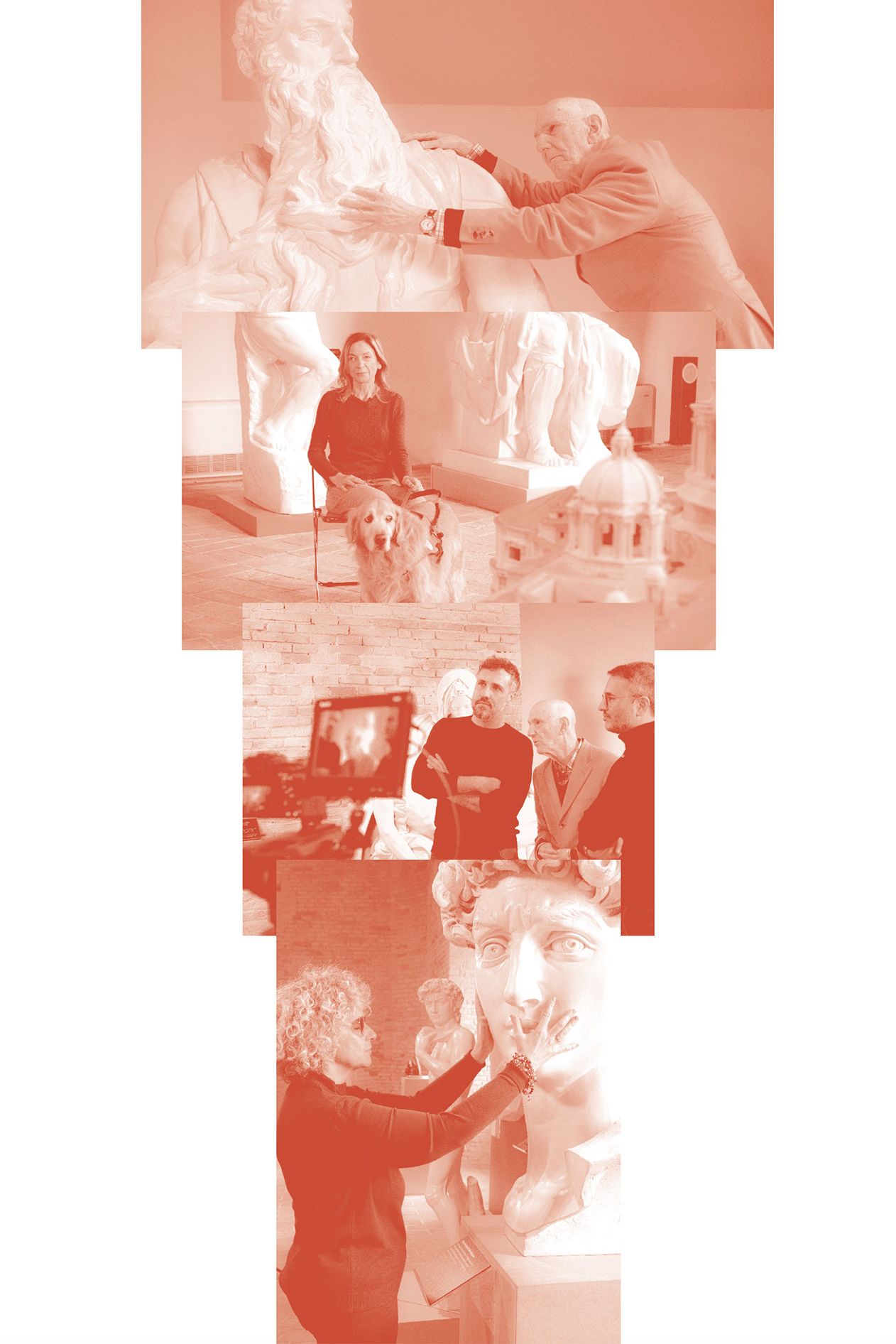
The exploration of this language and its relationship with reality and objects began at the Omero Tactile Museum in Ancona, a place where sensations stimulate the imagination of everyone, regardless of visual ability. Through touch, audio guides, and braille supports, the understanding of objects is freed from verbalism, reconnecting every word to a concrete experience.
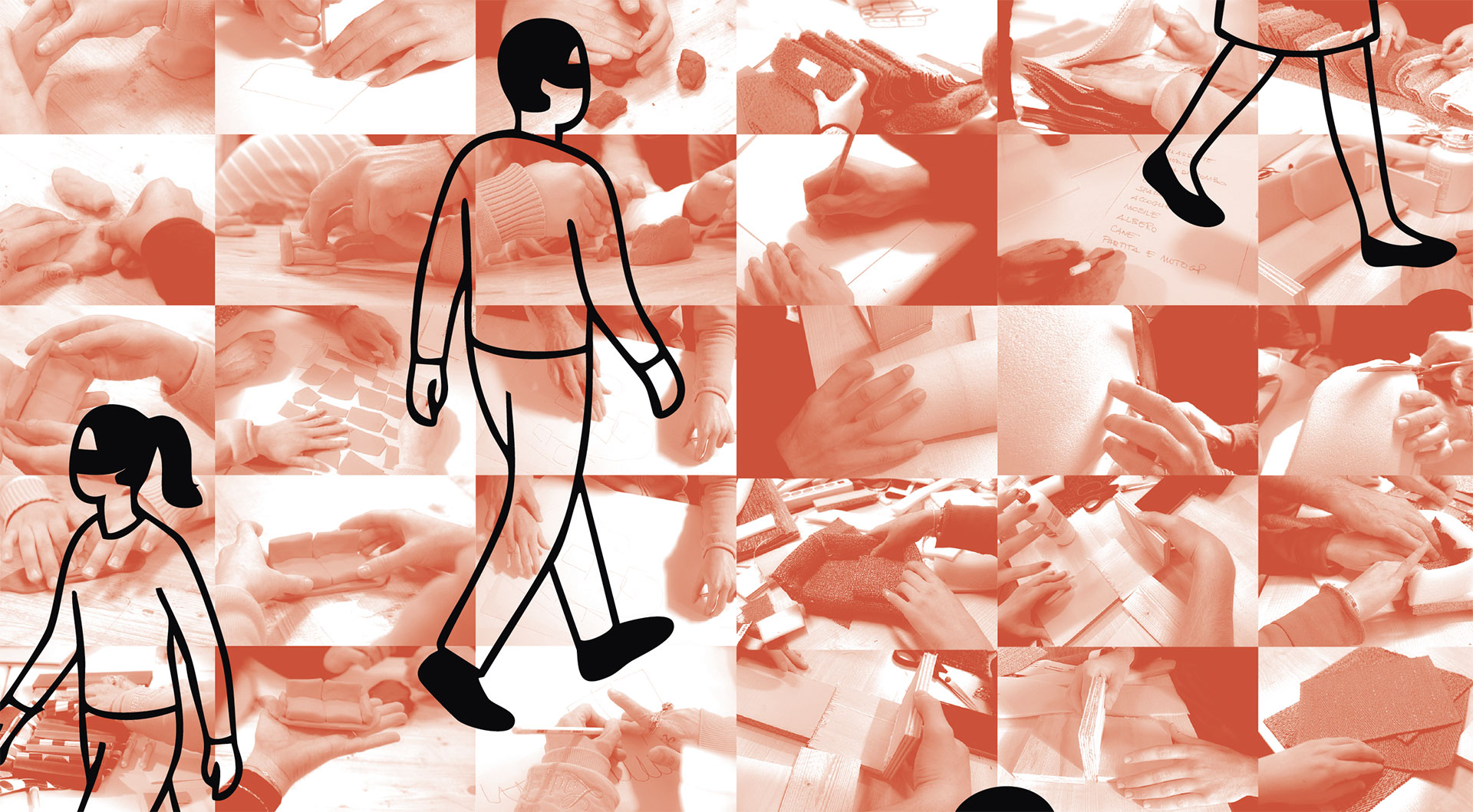
With the Francesco Cavazza Institute for the Blind, we experimented with design in a practical way, excluding sight and enhancing every other ability. Visually impaired and blind participants embarked on a journey of discovery through a miniature sofa construction workshop, experiencing direct contact with Adrenalina’s design through touch, sound, weight, temperature, and shape, culminating in the co-design of a sofa with Studio Debonademeo.
From these encounters, it emerged that beauty arises from the balance between functions, proportions, and sensations and can be explored without the use of sight. This activates a dialogue of gestures and words that connects places, objects, and people.

The project “Adrenalina Incontra Museo Omero e Istituto Cavazza” represents an important opportunity for the Francesco Cavazza Institute for the Blind in Bologna, as it explores the dialogue between design and visual disability, placing sensory experience and inclusive design at its core. The heart of the project is the creation of a sofa designed without the use of sight, prioritizing other senses such as touch, hearing, and smell. The process involved the active participation of some students from the Institute, who were directly engaged in the stages of research, exploration, and ideation, in collaboration with Debonademeo Studio.
This initiative provided blind and visually impaired young people with an immersive and interactive experience, giving them the freedom to create through their senses, overcoming the traditional reliance on sight. This approach stimulated a new form of creativity, where the absence of one sense becomes a catalyst for an alternative and deeply human design process. The goal was to enhance the design capabilities of people with visual disabilities, recognizing them as fully-fledged designers and making tangible a design based on sensations, listening, and exchange.
The project represents an innovative example of inclusion and active participation, where design not only adapts to the needs of blind and visually impaired people but is born from their direct contribution, transforming the perception of design itself into an open, accessible, and shared space, capable of welcoming and valuing every diversity.

“Parents should be told: let them touch!
Allow your children to feel things,
let them experience life concretely, even
at the risk of a few scratches.”
Pier Michele Borra
The sofa is no longer just an aesthetic object
to beautify a space, but an element that creates
experiences, makes people feel at ease, and adapts
to the needs of those who use it.”
Valentina

Being a partner of the project “Adrenalina incontra Museo Omero e Istituto Cavazza” represents a valuable opportunity for the Omero State Tactile Museum to extend its mission beyond the traditional context of cultural heritage. Our museum has always promoted accessible art, where tactility and multisensoriality are not merely tools of knowledge but authentic expressive languages. It is therefore natural to extend this vision to the world of design, which is not only about aesthetics but also about how objects interact with our bodies and senses.
The collaboration with Adrenalina and Debonademeo Studio marks a new step in this direction. We have worked together to rediscover design through touch, sound, weight, temperature, and shape, deliberately excluding sight as the predominant sense. This experience allows us to demonstrate that design can be inclusive not only in its use but already in the design phase, involving blind and visually impaired people in the creation of objects designed for everyone.
I am confident that the FuoriSalone in Milan will be an opportunity to reaffirm that art and design are not just to be seen: they are to be touched, listened to, and lived.

“It’s not about charity,
but about building opportunities,
professionalism, and research prospects.”
Fabio Fornasari
Adrenalina meets Museo Omero and Istituto Cavazza access - Adrenalina

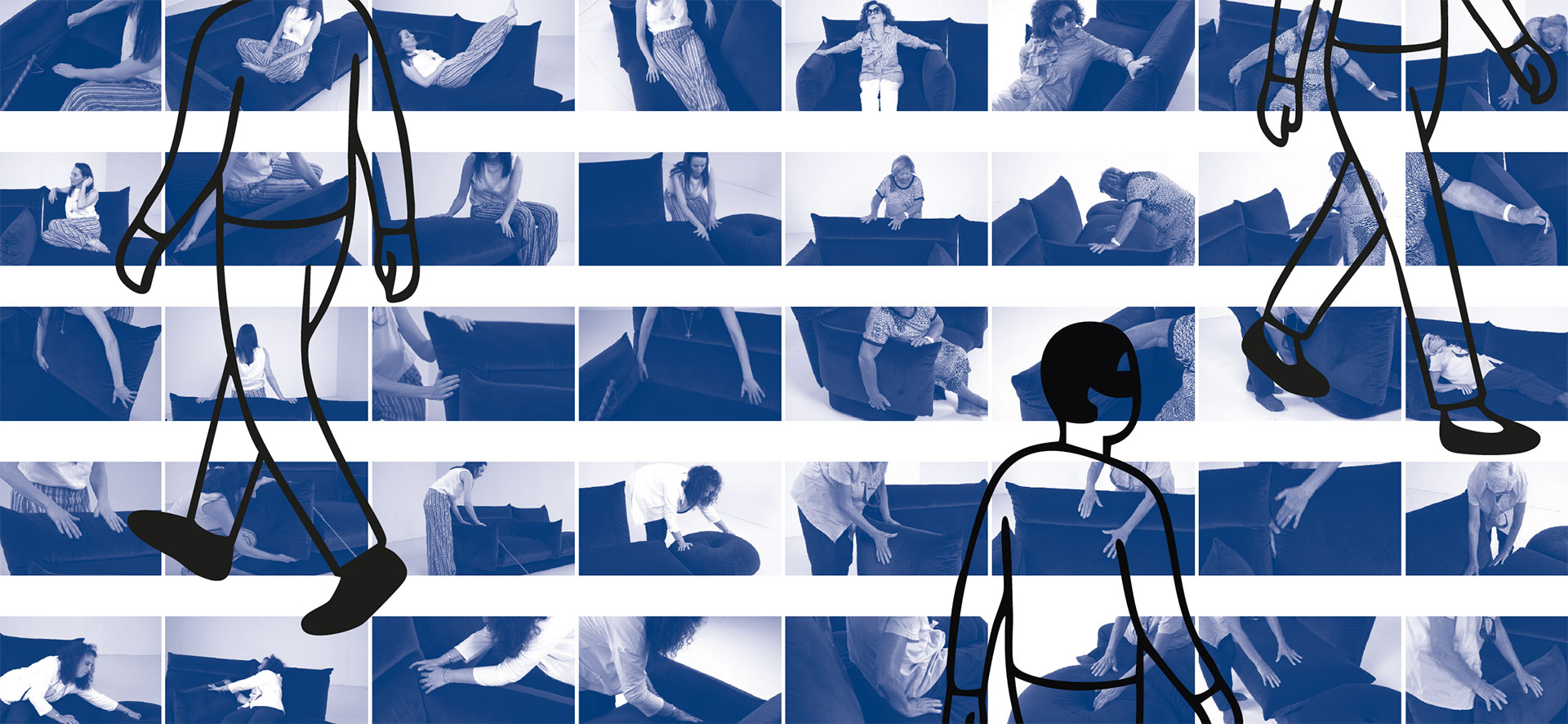
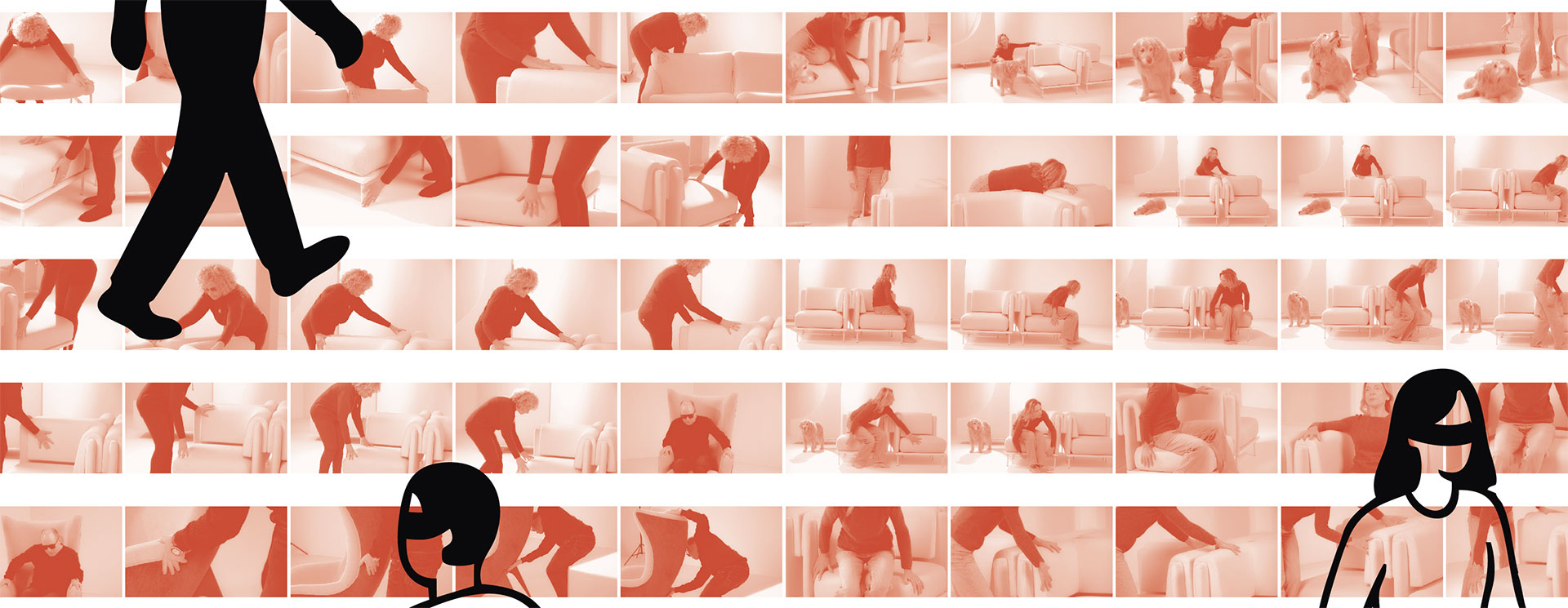
A series of photographs showing various people exploring Adrenalina sofas and armchairs, all images tinted in red

The Omero State Tactile Museum is a unique institution dedicated to accessibility and multisensoriality in art, specifically designed for blind and visually impaired individuals. Founded in 1993 by the Municipality of Ancona with the support of the Marche Region and inspired by the Italian Union of the Blind, it became a state museum in 1999. Since 2012, it has been located in the Mole Vanvitelliana, an evocative eighteenth-century building on the water, and since 2017, it has displayed its collection in 1,700 square meters of permanent exhibition spaces, enriched in 2021 by the Design sectaion.
The exhibition path includes over 200 works, including reproductions of classical sculptures and famous architectures, architectural models, and original sculptures by contemporary artists such as De Chirico, Pomodoro, and Pistoletto. The Design section features 32 iconic objects, including the Piaggio Vespa and the Bialetti Moka.
The museum is fully accessible: all works can be explored through touch, captions are provided in Braille and high-contrast text, and there are audioguides, tactile supports, and facilitated routes available. It organizes educational workshops for schools and families, training courses on museum accessibility, and traveling exhibitions.
Lastly, the Omero Museum stands out for its research in typhlodidactics, creating tactile aids, three-dimensional models, and accessible books. It publishes the magazine “Aisthesis,” dedicated to art and multisensory perception, and provides consulting services on the accessibility of cultural heritage.

The Francesco Cavazza Institute for the Blind in Bologna, founded in 1881, has undergone various organizational phases while consistently pursuing its mission of promoting social inclusion for visually impaired individuals. Until the 1970s, it supported higher education and university access for numerous blind students. Subsequently, it promoted school inclusion through the creation of the Regional Center for the Production of Educational Materials, facilitating the integration of blind children into public schools.
For around twenty years, the institute produced educational and typhlo-technical materials, including Braille textbooks, and launched university courses for support teachers. From the 1980s, it started offering professional courses for telephone switchboard operators and programmers, issuing recognized qualifications with the support of the Emilia-Romagna Region. At the same time, it promoted the dissemination of talking books and audio periodicals for blind and visually impaired individuals on a national scale. Since 1998, the institute has been enhancing accessible art through the creation of a museum of three-dimensional works, and more recently, it has developed an experimental space that combines art, technology, and sensory perception. In the 1990s, it established a low vision clinic and a rehabilitation center equipped with specific aids and dedicated software.
The institute, a member of the Consulta tra Antiche Istituzioni Bolognesi, has also adapted its structure to address complex forms of disability, integrating interventions for sensory, physical, and mental impairments. It has positioned itself as a national reference point not only for visual disability but also for more comprehensive disability support.

“It is extremely difficult to explain
what beauty is because beauty is an
entirely individual concept.”
DANIELA
Adrenalina meets Museo Omero and Istituto Cavazza access - Adrenalina

Roberta, Stefania and Aldo Grassini at Museo Omero exploring art works, Luca de Bona and Dario de Meo Art Director look at the camera

Adrenalina meets Museo Omero and Istituto Cavazza access - Adrenalina

Photographs of hands assembling miniature sofas

Milano Design Week 2025
Moscapartners Variations
Palazzo Litta Corso Magenta 24
7th/13th April

Presented as part of the MoscaPartners Variations exhibition at Palazzo Litta during Milan Design Week 2025, the installation offered a synesthetic and multisensory approach to design, where beauty was measured by the balance of function, proportion and sensation.
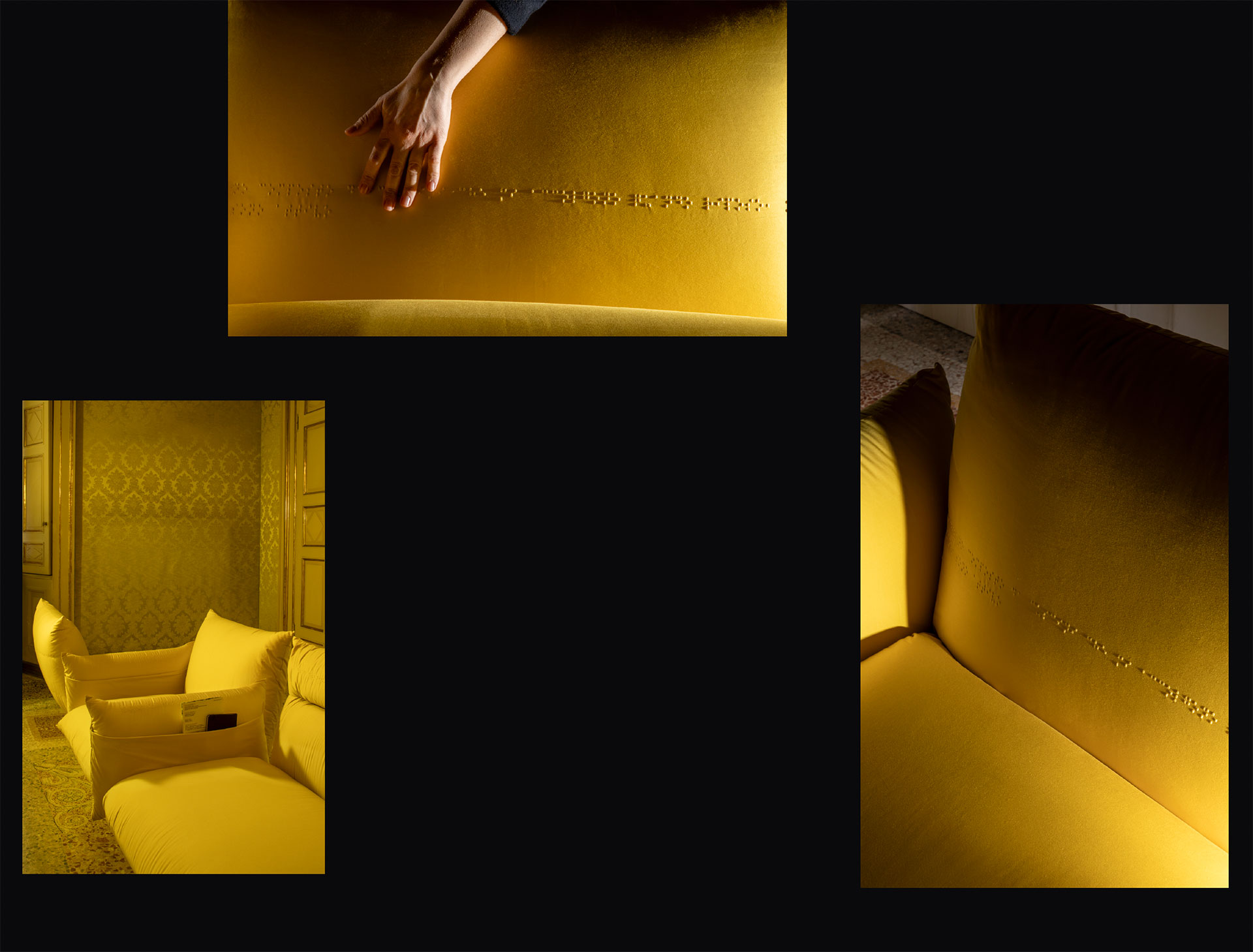
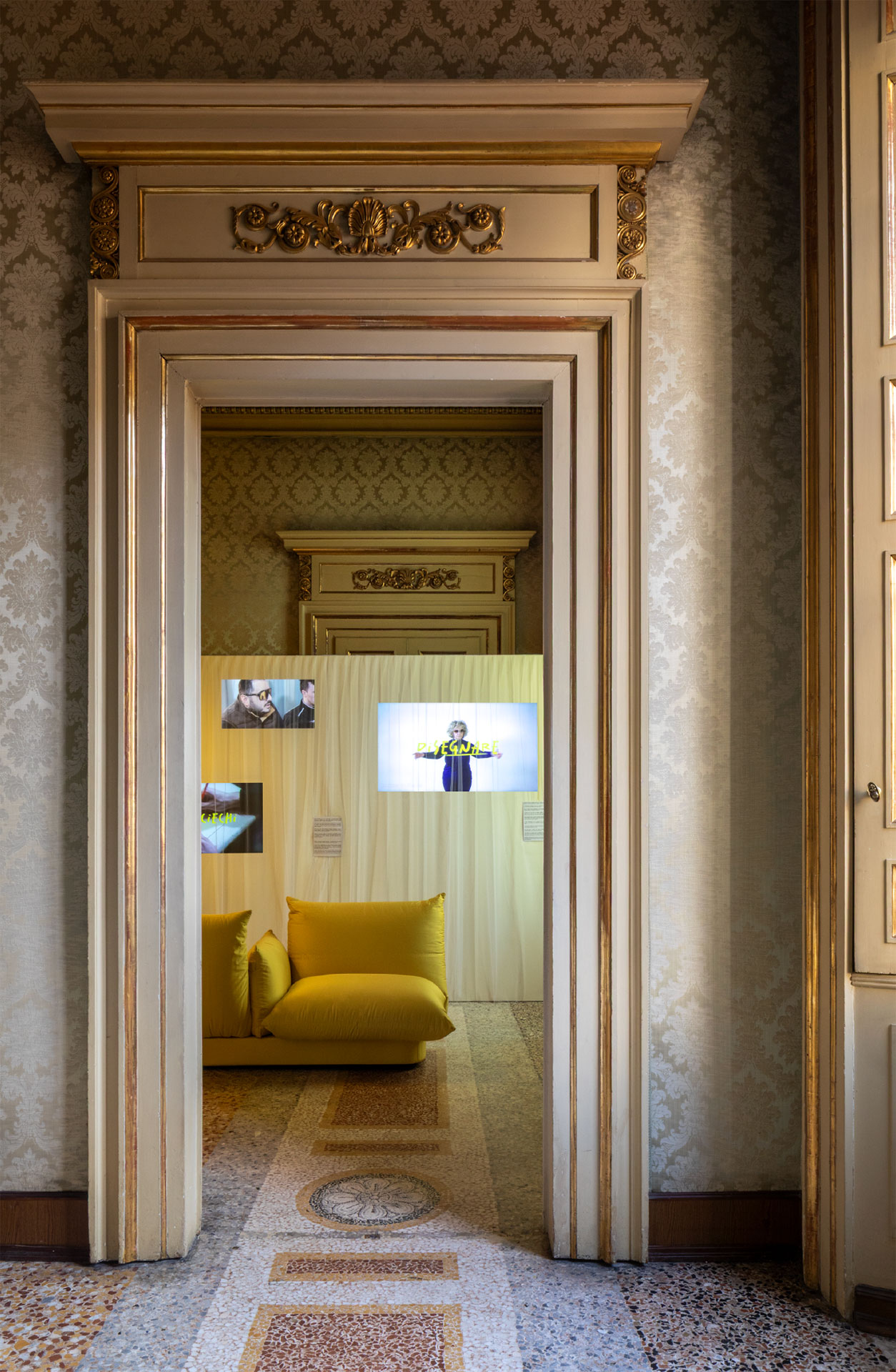
At the centre of the space, in an immersive environment flooded with yellow light, stood the Aedo sofa, upholstered in yellow satin — a colour that is among the most perceivable to people with visual impairments — with Braille embroidery capturing phrases expressed by blind and visually impaired participants during the co-design process. Surrounding the room were a series of monitors veiled by semi-transparent drapes which displayed a documentary narrating the project’s origins through video, sound and spoken word. This captured the collective nature of a journey connecting places, objects and people — a continuous dialogue between hands, voices, objects and spaces.
For the first time in the history of Milan Design Week, guided tours within Palazzo Litta were conducted by blind and visually impaired guides from the Cavazza Institute, offering a tactile exploration of all the installations accompanied by audio guides designed for blind, visually impaired and sighted visitors wearing blindfolds.
This installation brought to life a collaborative project embracing inclusion, well-being and perception, transforming design into a shared, accessible and deeply human experience.
Key moments of this journey were captured in a documentary, which distils the experience into a dialogue of gestures and words connecting people, spaces and objects alongside the Fuorisalone installation.

Adrenalina meets Museo Omero and Istituto Cavazza access - Adrenalina

AEDO inside Palazzo Litta at Milan Design Week

Adrenalina meets Museo Omero and Istituto Cavazza access - Adrenalina

In the final phase of the co-design process, the Aedo concept evolved into a tangible product, coming to life where it all began: within the company and among the people who conceived, described and developed it.
This was the first step on a journey where every challenge was transformed into a chance to learn and grow. It closed one chapter while opening up new perspectives on the power of design to foster connection, understanding, and well-being.
The visually impaired individuals involved in the process were able to explore the finished sofa, testing its materials, ergonomics, accessibility and sensory qualities. They shared their feedback freely and confidently in an open dialogue with designers and technicians.
What began as an ambitious interdisciplinary experiment became a real, tangible experience — participatory design that moved beyond abstract concepts and was based on listening, trust, and an absence of hierarchy.
Aedo did not originate from a single idea that was then transformed into a universal object; rather, it emerged as a response to a shared question: “What should a sofa feel like to make you feel good — and beautiful — even without seeing it?”
In this process, beauty took shape beyond sight, manifesting in the curves, materials and warmth of the seat. The sofa became a spatial anchor and a means of orientation — an object that is both intimate and collective.
It was a project that didn’t simply include people, but truly involved them — and it was in this involvement that it found its true design strength.

“My hands have always been my eyes.”
ROBERTA
Adrenalina meets Museo Omero and Istituto Cavazza access - Adrenalina

Visually impaired and blind people exploring the blue Aedo sofa

Aedo

design Debonademeo Studio
and visually impaired individuals

Aedo is the final result of an accessibility and design journey conceived for visually impaired individuals. It emerges from an unconventional process of investigation and co-design, where design transcends the traditional concept of beauty and proposes a new aesthetic standard based on perception. This sofa was not conceived through a visual approach but rather a tactile one: its shape is the result of dialogue, observation, and interaction with those who explore the world through touch.
Aedo overturns perceptual rules related to color and visual proportions, prioritizing materiality, functionality, and new ways of interacting with the domestic environment.

“We wanted to transform an oral story into
a graphic narrative: Braille becomes a decorative
element, readable both by touch and sight, creating a
dual language between blind and sighted people.”
Dario

Every detail arises from the direct experience of the visually impaired and blind individuals involved, who suggested more welcoming shapes, soft profiles, and differentiated surfaces to make perception more intuitive and nuanced. The encounter with their hands shaped a sofa capable of communicating without the need for sight, where every curve, fold, and texture variation is designed to be discovered through touch.
It is not a sofa designed “for” blind individuals but “with” them, proposing a universal model suitable for everyone. Evoking the classical figure of the aedi—blind storytellers who wandered through courts narrating myths and heroes—Aedo tells and interprets the marvelous daily life of those who use it. It is an object that speaks to everyone, reminding us that design is not just an image but an experience.

“It was supposed to be a journey into darkness,
an inner analysis… but instead, we embarked
on a journey into light and color.”
Luca
Adrenalina meets Museo Omero and Istituto Cavazza access - Adrenalina

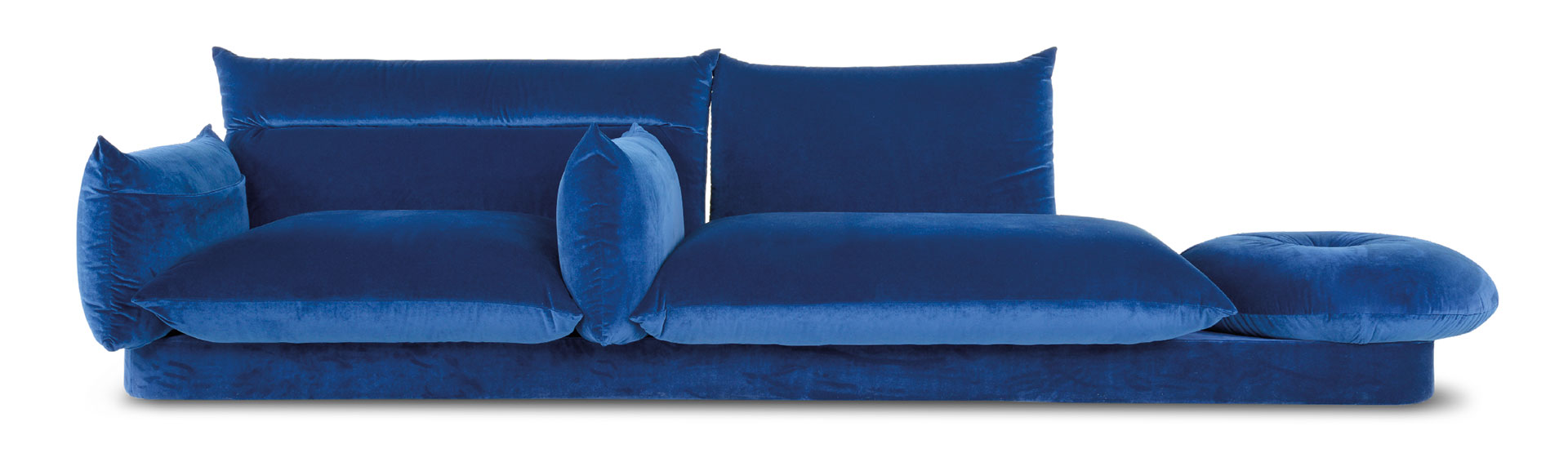
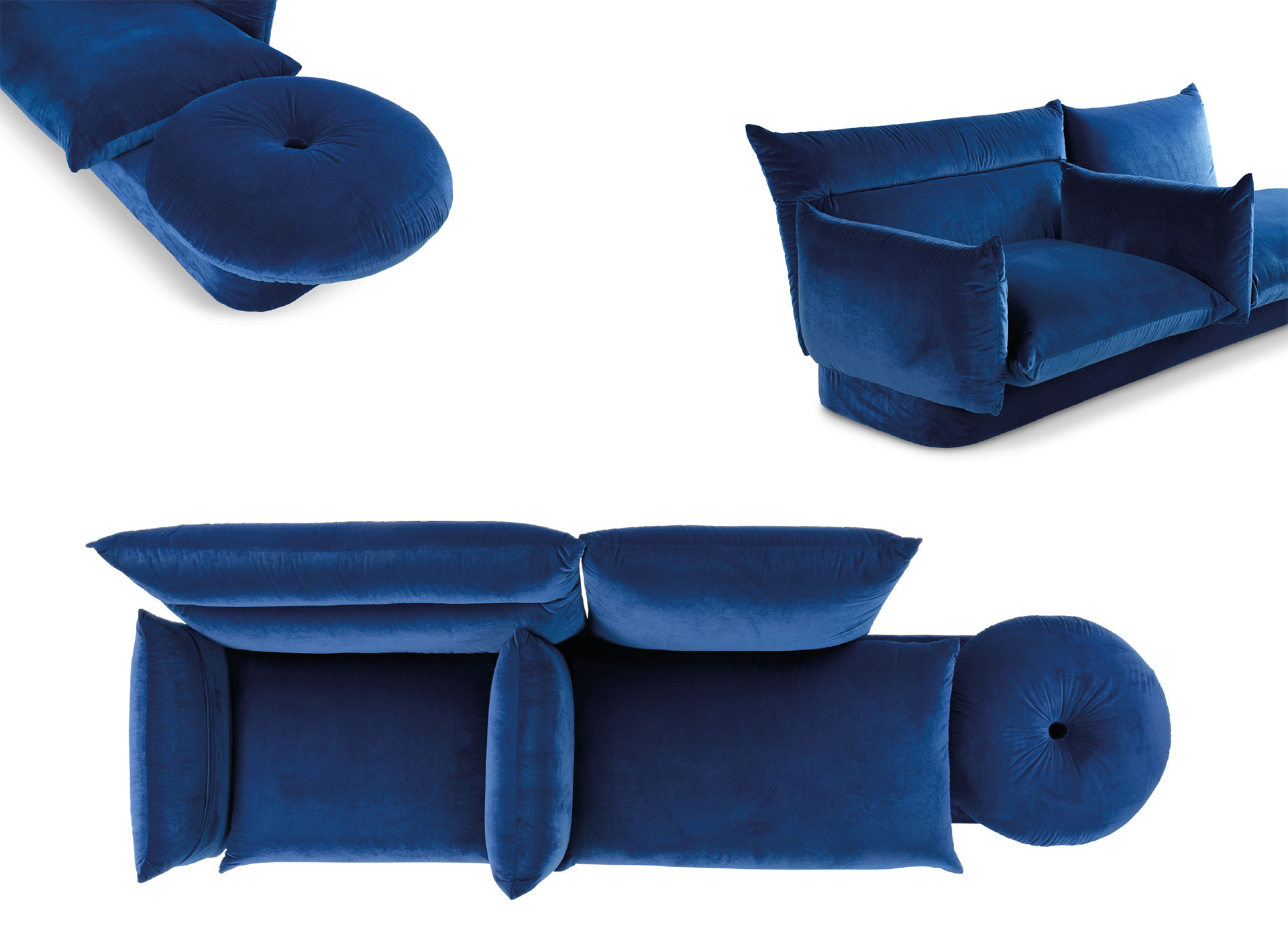
Blue AEDO sofa in various positions

IN PARTNERSHIP WITH
MUSEO TATTILE OMERO ANCONA
ISTITUTO DEI CIECHI FRANCESCO CAVAZZA BOLOGNA
ARCHITETTO FABIO FORNASARI

CURATORIAL PROJECT BY
DEBONADEMEO STUDIO
VALENTINA BIGIARINI

PHOTO / VIDEO
SAVERIO FEMIA
STEFANO BISULLI

VISUAL IMPAIRED PEOPLE
SIMONE, CHRISTIAN, ROBERTA, STEFANIA,
ALDO, DANIELA, MARCO, CAMILLA, GENNARO,
GIOVANNI, MARIANO, ANTONIO, VICTOR,
NICOLETTA, ROSA, MICHELA, GERTRUDE
E I CORSISTI DELL’ISTITUTO FRANCESCO CAVAZZA

SEEDING EYE DOGS
ITALO, JULIETTE

GRAPHIC & IMAGE
VZNSTUDIO

ART DIRECTION & SET UP
DEBONADEMEO STUDIO

Adrenalina meets Museo Omero and Istituto Cavazza access - Adrenalina